
Harald Prinz preached during a Eucharistic celebration on Sunday.
Last Sunday, I preached at a Eucharistic celebration. The church was full; a jubilarian sat in the celebrant’s chair—we were marking the 60th anniversary of his ordination to the priesthood. The parish had organized a lovely celebration for him: photos from his life as a priest were shown on a screen before the service to set the mood; there was choral and organ music during Mass; and afterwards, a reception with refreshments—there was even a mounted honor guard to greet the jubilarian at the church entrance. It was a beautiful occasion, and the 84-year-old jubilarian was deeply moved—though also visibly at the limit of his strength.
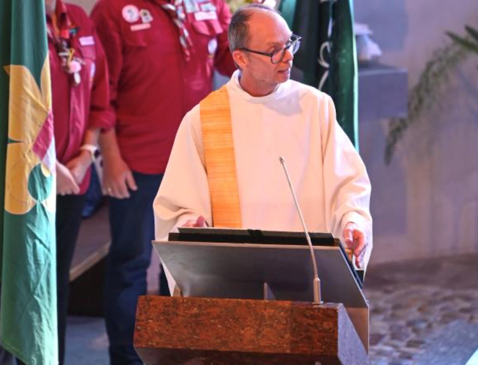 Photo: Peter SchrackHe had only a few roles during the service: the congregation was delighted by his liturgical greeting at the start; reading the Gospel—the account of the Risen Lord sending Mary Magdalene forth—almost proved too much for him; and during the Eucharistic Prayer and the Consecration, the pastoral assistant and I had to support him. During the Eucharistic part of the Mass, I briefly wondered if, for his sake, we should have divided up the various sections—taking turns speaking them among the three of us. Of course, that would have gone against liturgical norms, but it would have helped him. On the other hand, I reflected afterwards: who knows how many more times he will celebrate Mass himself, or if this might have been the very last time he ever recited the Eucharistic prayers? It was right just the way it was.
He had asked me to deliver the sermon, however. And I was glad about that, knowing how overwhelming it would have been for him to address the congregation himself in a sermon—and vice versa. This way, though, I had the opportunity to thank him during the homily for his sixty years of pastoral and priestly service, to draw a parallel between him and Mary Magdalene, and to articulate for the congregation what a Christian mission can mean today. It was all very fitting—for him, for the congregation, and for me. It was also appropriate and dignified; in a positive Christian sense, it was perhaps even missionary in nature. Yes, that is a valid thing, too: that those attending the service do not merely sit through a sermon but take something away with them into their own lives and their own Christian faith.
The crux of the matter, however, is that I am not a priest. And therefore, I am not permitted to preach during a Eucharistic celebration. The fact that I studied theology, possess some rhetorical aptitude, and have decades of preaching experience is beside the point. I am a layperson, and I am not allowed to preach during the Eucharist. Period. The Vatican has recently reiterated this stance. Of course, I was unaware of that specific recent ruling at the time of the anniversary sermon; the German Bishops' Conference published Rome’s definitive statement only two days later. Yet, I was certainly aware of the fundamental prohibition in canon law—and I disregarded it. Should I have obeyed canon Law?
Cardinal Roche in Rome would likely say "Yes!"—but what would have happened then? Should the jubilarian have preached himself? As already mentioned, he would not have been able to. Should there have been no sermon at all? That, in turn, is unworthy of such a celebration—or indeed of any church service, especially on a Sunday. Should we have cancelled the celebration entirely? But wasn't it wonderful to celebrate this occasion while the retired pastor was still alive, rather than scattering roses of gratitude only at his funeral? That, at least, was the view of one parishioner who was grateful for the celebration. So, how else should it have been done?
And that very question—how else it might be done—is the one Rome fails to ask. Cardinal Roche signals understanding for the pastoral crisis in Germany—a situation no different in Austria, France, the Netherlands, Brazil, and so on—yet he sticks to a "No" dictated by canon law (a rule that, incidentally, did not even exist in this form prior to 1983). He makes no real effort to consider how pastoral ministry or a dignified celebration of the Eucharist can actually function in such situations. After all, his suggestion that priests should constantly pursue further training to improve their preaching misses the mark entirely in the context of our jubilee service. Further training would have been of absolutely no help to our 84-year-old pastor. And he is not the only example: how often do we hear of foreign priests whose command of German is insufficient for them to preach in a way that is linguistically clear? One can certainly enroll them in language courses, but—we must be honest here—there are some who will never achieve the necessary level of proficiency. Then there are those who lack rhetorical skill and fail to get their point across, and others whose theological knowledge is inadequate. Or, for that matter, those who—due to age or health—no longer have the necessary strength. One is tempted to ask: Is this really acceptable? Yes, it is. Not every priest needs to speak perfect German, be young and agile, hold a doctorate in theology, or be an outstanding preacher. But those who *are* allowed to preach—they must be capable of doing so. I, for instance, do not stand up to sing the Exsultet. And why? Because I cannot do it. And so, I leave it to those who actually have the ability.
Proclamation is not merely a matter of willingness and authenticity, but also of ability. The same applies to preaching. Anyone who preaches must enjoy doing so, must be credible, and must possess the necessary skill—for the sake of the Gospel and the people. If Rome views, handles, and demands things differently, it commits a sin: against the people and against the Gospel.
And what about me? Did I also commit a sin by preaching at the jubilee celebration of my old pastor—who, incidentally, baptized me as a child and with whom I therefore share a special bond? I do not think so.
Dr. Harald Prinz
Deanery Enns-Lorch
Austria
24 June 2026