There are over a billion Catholics around the world. Women have always played a significant role in the life of the Church - but have been excluded from the Catholic hierarchy.
A number of devotees say they feel called upon to serve God as priests, but the Vatican has never allowed female ordination to priesthood. Now, there's a growing movement to change this.
Over 200 women have chosen to take part in secret ordination services, despite knowing they will be excommunicated from the Church. BBC 100 Women follows two women who have been unofficially ordained in the US and Colombia. Is there a future for women priests? And can this change happen in our lifetime?
We Are Church calls for Equal Numbers of Voices for Laity and Clergy at the October 2023 and October 2024 Synod meetings
The Synodal Process called by Pope Francis has already exceeded expectations.
Laity and clergy have been meeting and listening at many levels:
Parishes
Dioceses
National
Continental
The Continental (DCS) document presents a good summary of the wide range of issues raised around the world and the Continental meetings in February and March 2023 will have balanced teams of laity and clergy representing each country.
The same balance must be maintained as we approach the two upcoming Synod sessions in Rome. Synodality means sharing decision making and decision taking. Thus, we urge church leaders to ensure that balanced teams of laity and clergy are present at the October 2023 and October 2024 meetings and that lay members have the same deliberative authority as clerical members. A Church of equals should be represented in the Synod by having representatives according to the plurality exisiting in the Church with respect to many important issues eg. Women; LGBTQ+ people; Laity in decision taking at all levels.
"No one puts new wine into old wineskins: otherwise, the wine will burst the skins, and the wine is lost, and so are the skins: but one puts new wine into fresh wineskins" (Mark 2:22)
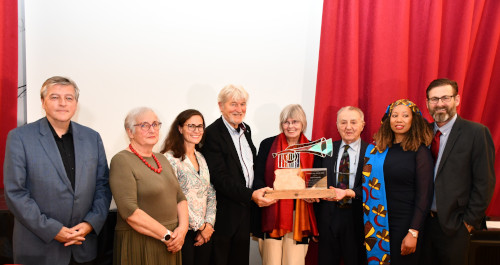
Von links nach rechts: Helmut Schüller (Pfarrerinitiative), Erika Smutny (Laudatio statt Rudolf Mayerhofer-Sebera, der an Corona erkrankt ist), Lena Pampalk-Lorbeer (Tochter von Preisempfänger Josef Pampalk), Ewald Benes (Laieninitiative), Martha Heizer (Wir-sind-Kirche AT), Preisempfänger Josef Pampalk, Esperanca und Prof. Eric Morier-Genoud (Mosambik, bzw. Belfast)
Josef Pampalk war als Missionar der „Weißen Väter“ in Mosambik Zeuge, wie sich die dortigen Bischöfe der Kolonialmacht Portugal anpassten und welche Folgen das hatte. Ein Konkordat von 1940 zwischen Salazar und dem Vatikan verfügte, dass die Missionen explizit als eine Agentur im Dienste des portugiesischen Imperiums galten und dass die Kolonialregierung die Bischöfe aussuchte und bezahlte, dafür von ihnen eindeutige Unterstützung bei der Aufrechterhaltung des Kolonialismus erwartete. Wer kritisierte oder für die Rechte der Einheimischen eintrat, wurde bestraft oder des Landes verwiesen. Die „Weißen Väter“ entschlossen sich zu einem öffentlichen und gemeinsamen Protest. Daher wurden sie 1971 aus Mosambik ausgewiesen. Die Haltung des Vatikans im Sinne einer Unterstützung des Kolonialismus führte dazu, dass Pampalk und andere „Weiße Väter“ ihr Priesteramt niederlegten.
Als erstes sollte natürlich die Stagnationsbruderschaft im Vatikan, die dafür verantwortlich ist, ihren Fehler bereuen und nach Wiedergutmachung streben. Aber wer sich Unfehlbarkeit anmaßt, tut sich da naturgemäß schwer.
Als einen Schritt zur Wiedergutmachung für das Unbill und Leid, das die Weißen Väter ertragen mussten, erhielt daher stellvertretend Josef Pampalk von den Kath. Reformorganisationen Österreichs die Trompete von Jericho 2022 überreicht
Press Communiqué from the General Secretariat of the Synod
This morning, at the end of the Sunday Angelus, the Holy Father announced that the upcoming 16th Ordinary General Assembly of the Synod of Bishops will be held in two moments, that is, in two sessions, spaced one year apart: the first from October 4 to 29, 2023, the second in October 2024. Pope Francis referred to the Apostolic Constitution Episcopalis Communio, which contemplates this possibility (cf. Article 3).
This decision stems from the desire that the theme of a Synodal Church, because of its breadth and importance, might be the subject of prolonged discernment not only by the members of the Synodal Assembly, but by the whole Church.
Moreover, this choice is in continuity with the ongoing synodal journey, to which the Pope himself referred this morning. The Synod is not an event but a process in which the whole People of God is called to walk together toward what the Holy Spirit helps it to discern as being the Lord's will for his Church.
Therefore, the Ordinary General Assembly of the Synod of Bishops will also take on a processual dimension, configuring itself as "a journey within the journey" to foster more mature reflection for the greater good of the Church.
From the very beginning, the General Secretariat of the Synod has chosen the path of listening and discernment, even in the planning and implementation phase of the synodal process. In the coming weeks, we will continue our discernment to better define the celebration of the two sessions of (and the time in-between) the XVI Ordinary General Assembly of the Synod of Bishops. We will communicate about this in due time.
This listening process began in 2021 by the local Churches, that is, by the People of God gathered around their Pastors; it has challenged the Bishops' Conferences and Synods of the Eastern Catholic Churches. As many as 112 out of 114 Episcopal Conferences all the Eastern Catholic Churches carried out a discernment regarding what emerged in the particular Churches. Now, it continues with a Continental Stage that will culminate with the celebration of Continental Synodal Assemblies, between January and March 2023. These Continental Synodal Assemblies will be convened to reread the journey made and to continue the listening and discernment, having as their point of departure the Document for the Continental Stage, and proceeding in accord with the socio-cultural specificities of their respective regions. Their aim will be to carry out one more step in this spiritual journey.
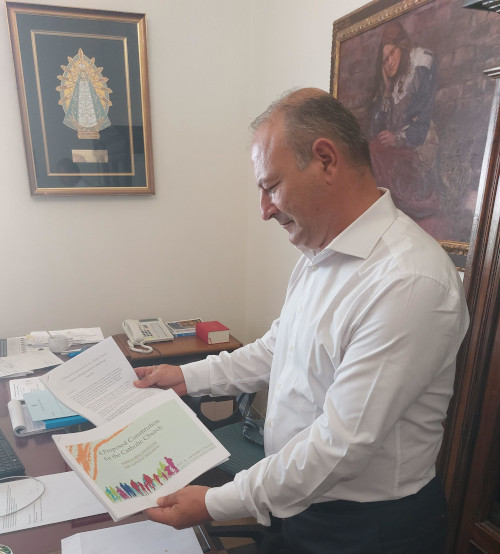
Thierry Bonaventura taking receipt of the proposed constitution at the Synodal Office – 26-8-2022
The Wijngaards Institute for Catholic Research (more here) has submitted revolutionary proposals to the Synod on Synodality, a worldwide consultation of Catholics kick-started by Pope Francis on the theme of a more participatory church. The Institute proposes that the Catholic Church adopt a Constitution that would underlie its ecclesiastical laws. The Constitution would revolutionise the present structure of the Church.
According to Prof. Mary McAleese, former President of Ireland, now Chancellor, Trinity College, Dublin, Ireland: “This proposed Constitution is the best idea the Catholic Church has had in centuries. It gives due respect to the God given dignity of every member, puts Christ front and centre, loosens the strangling, controlling grip of imperialism and clericalism and lets the Church breathe again, love again, include again. We need this Constitution. It is our bridge to the future”.
The constitutional text is the result of a year’s work by an international, interdisciplinary working group of 25 academics, coordinated by the Wijngaards Institute. The draft text was further scrutinised by a wider group of scholars resulting in the final text being signed by over 60 international experts.
The Catholic Church is currently structured around an unelected, self-selecting male-only priestly caste, which alone wields all legislative, executive, and judicial power. It inherited this structure from the centralised authority of the Roman Empire and feudal society in the Middle Ages. Laypeople, who account for more than 99% of church members, are excluded from church governance, and women and LGBTQ people doubly so on account of their gender and sexual orientation.
The new ground-breaking Constitution for the Catholic Church proposes to radically overturn that structure. It codifies democratic features which are consistent with precedents in the bible and church history, and the fundamental human rights which successive popes have encouraged states to respect, but which current church law is far from integrating.
· To kick-start discussion of the need and possible shape of a church constitution;
· To build on the official Vatican precedent, the so-called “Lex ecclesiae fundamentalis” (“Fundamental law of the church”), whose final, finished draft was shelved in 1981;
· To establish a legal framework for agreed legal rights, principles, and standards which all church laws must abide by, and against which they must be assessed;
· To shows how proposals for church reform can be brought together into a legal framework that is coherent, pragmatic, as well as compatible with biblical studies, theological research, and ecumenical dialogues.
The constitution was submitted to both the national episcopal conferences of all the countries the co-signatories come from, and to the General Secretariat of the Synod of Bishops. On August 26th, we met with and hand delivered a copy to Thierry Bonaventura, the communications manager of the Synodal office in Rome (see photo below) who stressed that he, Sister Becquart and all the Synodal committee would review the document in detail. We have also heard from a Bishop and member of the committee to decide which of the contributions from Western European Catholics will be submitted to the next phase of the synod, who said he will bring the constitution to the attention of his colleagues at that committee.
Key features and proposals:
Universal right to participate in church governance. All Catholics have a right to participate in the government of the church, as required both by their fundamental human rights (UDHR Art. 21) and by their baptismal rights.
Non-discrimination. The selection of candidates for any church office, including sacramental ministry, must be done without discrimination based on race, gender, sex, sexual orientation, marital status, and economic or social condition.
Subsidiarity, federalism and decentralisation. “Every church and decisional level in the church has an inalienable right and responsibility to determine both what decisions and actions falls within their competence, and what instead should be decided by delegation to, or accomplished better in cooperation with, the higher level. Conversely, each higher decisional level may only undertake those decisions and actions which the lower level freely delegates to them, and may not impose restrictions on the lower levels as to matters for decision or action without their consent” (Art. 34, see Art. 30).
Leaders must be elected and representative of their constituents. Church officials exercising legislative or executive functions must be representative of the church community they serve. Accordingly, at each level of church governance, candidates to those ministries should be elected through direct or indirect universal suffrage.
Consent. “Official church laws and doctrines passed by church representatives must reflect the consent of the churches to which they apply, and they are to be regarded as valid for as long as they enjoy that consent” (Art. 31).
Separation of powers. The power of governance shall be divided between the legislative, executive, and judicial branches. Each branch is separated from the others, as well as from the so-called “sacramental power”, so that “A person or body holding one of those powers […] shall not concomitantly hold any of the others”. In other words: priests and bishops can only exercise the sacramental power, and they can no longer exercise any of the powers of governance (legislative, executive, or judicial), and much less do so exclusively.
Leaders are legally required to take into account specialist knowledge whenever required by the matter at hand: “Should a decision require specialist knowledge – e.g., in biblical studies, theology, canon law, medicine, psychology, economics, sociology, etc. – church representatives and leaders, both individually or in groups, have a legal duty to seek and take into account relevant and independent expert advice” (Art. 68). “Membership of […] independent expert advisory bodies shall be selected via an open and transparent peer review process, whose criteria for selection must include relevant expertise, lack of conflict of interests, independence from church representatives and church leaders, and good standing within the relevant scientific community” (Art. 70).
Leaders must be accountable. Church officials exercising legislative or executive power must only serve for a limited term of office, recommended to be five years. They should report at least annually on their actions, including their financial management.
There must be full freedom to Join and Leave the Church. “By virtue of the universal freedom of conscience and religion, acquiring as well as relinquishing juridical membership of the Catholic Church entailing the acceptance of ecclesiastical rights and responsibilities must be the result of a free choice. (Art. 5).
A full list of contributing scholars, endorsements and supporting organisations is here: Scholars and Signatories
Contact :
Miriam Duignan : T +44 7970 926910 E This email address is being protected from spambots. You need JavaScript enabled to view it. Dr Luca Badini Confalonieri: T: + 44 7446 283699 E This email address is being protected from spambots. You need JavaScript enabled to view it.

 This morning, at the end of the Sunday Angelus, the Holy Father announced that the upcoming 16th Ordinary General Assembly of the Synod of Bishops will be held in two moments, that is, in two sessions, spaced one year apart: the first from October 4 to 29, 2023, the second in October 2024. Pope Francis referred to the Apostolic Constitution Episcopalis Communio, which contemplates this possibility (cf.