fpage
-
‘Becoming a synodal church together!’
Appeal from We are Church to the European participants of the World Synod 2024 at the preparatory meeting from 29 to 31 August 2024 in Linz
August 2024
The international Catholic reform movement We are Church very much welcomes the fact that voting synod members and theological experts from Europe will be preparing together in Linz/Austria at the end of August 2024 for the second plenary assembly of the World Synod in Rome in October 2024. The European Continental Assembly in February 2023 in Prague/Czech Republic, which We are Church and other reform groups had accompanied, still revealed very clear differences between the local churches and bishops' conferences in their understanding of the church and church practice.
The Roman Catholic world church is currently in an important transitional phase. In contrast to the Second Vatican Council (1962-1965), which intended a theological revaluation of the local churches, a centralised understanding of the church was consolidated during the last two pontificates. Pope Francis has revised this in many small steps and led the Church back onto the course of the Council.
The worldwide synodal process initiated by Pope Francis is now pursuing the goal of developing a common vision of the local churches of ministries, charisms, services and other forms of activity in the community of believers, based on the ecclesiology of the People of God of the Second Vatican Council. Due to the long divisions of Europe, this Council was received very differently. This is why theological and cultural exchange is now so important, especially among the churches in Europe.
Responsibility for the local churches
We are Church welcomes the proposal in the preparatory paper (‘Instrumentum laboris’) for the assembly in October 2024 that the local churches ‘should be recognised as ecclesial subjects endowed with doctrinal authority’. In the context of a diverse Church, the ‘valorisation of liturgical, disciplinary, theological and spiritual expressions adapted to the different socio-cultural contexts should be promoted.’ (97 a)
From the perspective of We Are Church, however, it is equally important to ‘develop effective forms and procedures of transparency and accountability that are... appropriate to the diversity of contexts’ (78). Therefore, the people of God, the people of the church, must be involved in a representative manner not only in decision making, but also in the final decision. A synodal church requires changes in the structures in which women in particular can participate in decision-making on an equal footing, not just in consultation.
Questions for the future of the church
The non-transparent outsourcing of individual issues to ten study groups, which resulted from the first assembly of the World Synod in Rome in October 2023, must not mean a delay in urgently needed reform steps. Rather, it is to be hoped that the so-called ‘women's question’ in particular will be discussed openly, as it was at the synod in October 2023. Women must no longer be denied ordination! Equal rights for women and queer people are crucial for the credibility of the church.
In the struggle for the future of the church, pastoral and structural issues should no longer be played off against each other! The problematic church structures that have led to abuse and loss of trust must be permanently corrected! As important as the basic line of evangelisation laid down by Pope Francis is, a real reappraisal of sexualised and spiritual violence is an essential element of evangelisation! The Gospel takes sides with the disenfranchised, the maltreated and the wounded. Without this perspective, any attempt at evangelisation will come to nothing.
Model for democracies
In a time of political upheaval, in which authority, especially authority from above, is no longer readily accepted, church synodality could also be a good model for democracies. We are Church supports Cardinal Jean-Claude Hollerich, Relator of the World Synod, in his statement: ‘Yes, we don't just need one theology of synodality, we need different theologies of synodality. We need reflection so that the Church of God can move forward in time and recognise the signs of the times in our world."
Background
European synod participants meet in Linz at the end of August. The meeting from 29 to 31 August 2024 at the Faculty of Theology of the Catholic Private University (KU) Linz will be hosted by the local pastoral theologian and Dean Prof. Klara Csiszar.
Other members of the preparatory group are the Vice-President of the Council of the Bishops' Conferences of Europe (CCEE), Archbishop Ladislav Nemet from Belgrade, as well as the synod experts Prof Christoph Theobald (Paris) and Prof Myriam Wijlens (Erfurt). The meeting will be accompanied spiritually by Prof Tomas Halik (Prague).
Similar preparatory meetings prior to the second plenary assembly of the World Synod from 2 to 27 October 2024 in Rome have also taken place on other continents.
Press contact:
Colm Holmes, chair We are Church International,
This email address is being protected from spambots. You need JavaScript enabled to view it. (Ireland)Martha Heizer, vice-chair We are Church International,
This email address is being protected from spambots. You need JavaScript enabled to view it. (Austria)Christian Weisner, We are Church,
This email address is being protected from spambots. You need JavaScript enabled to view it. (Germany)Mauro Castagnaro, Noi siamo Chiesa,
This email address is being protected from spambots. You need JavaScript enabled to view it. (Italy)Alicja Baranowska, Women's Ordination Worldwide,
This email address is being protected from spambots. You need JavaScript enabled to view it. (Poland) -
‘Sobering results, continuing controversy’
Catholic reformers at the end of the 6th Synodal Assembly:
Press release Stuttgart, 31 January 2026
The Federation of German Catholic Youth (BDKJ), Parish Initiative, Catholic German Women's Association (KDFB), Maria 2.0, #OutInChurch, pro concilio and We Are Church draw a sobering conclusion at the end of the sixth and final Synodal Assembly in Stuttgart. Even before the assembly, eight Catholic reformers had clearly formulated their specific expectations and were present in Stuttgart.
Following the shocking findings of the MHG study, the German bishops, in joint responsibility with the Central Committee of German Catholics, launched a Synodal Path in 2019, which, despite all the difficulties, has attracted worldwide attention. Based on the risk factors of sexualised and spiritual violence and cover-ups according to the MHG study, the systemic causes of power structures, the image of priests, discrimination against women and sexual teaching have been intensively addressed, all of which are also obstacles to credible evangelisation. This is a great and lasting achievement.
Progress despite obstacles
At the same time, it should be noted that the Synodal Path has not fulfilled many expectations and hopes, nor could it do so. The current canon law regulations are too restrictive, making it impossible for the laity to participate effectively in important decisions. Added to this is the irresponsible withdrawal of individual bishops from the entire process. A major problem with all the results of the German Synodal Path to date is that, according to current canon law, the bishops still have ultimate responsibility, especially in the area of finances.
The Synodal Path has adopted good basic and action texts in the synodal assemblies and synodal forums, but these must now be implemented promptly and consistently. We are pleased that these texts, especially those on gender justice issues, are encouraging Christians around the world to actively pursue reforms in their own communities. However, it has also become clear that the hard-won decisions of the Synodal Path have so far received too little recognition in the Vatican. Therefore, further productive dialogue is urgently needed.
The presentation of the monitoring of the decisions has shown that more transparency is needed where implementation is still pending. Here, we call on the diocesan bishops to publish the findings from their dioceses. This has not been the case in the monitoring so far. Only in this way can the faithful demand consistent implementation at the local level. It remains a challenge to create safe places for all people, but especially for women, children, young people and queer people.
Continuing to live out synodality
And yet we look with gratitude to those who have supported and lived out the spirit of synodality and reform over the past six years. These were primarily the laity, but also some of the bishops. Here, we expect all participants to actively participate in the synodal deliberations in the future. The official final declaration adopted today summarises with necessary openness what the Synodal Path in Germany has initiated and achieved, but also what still needs to be worked on intensively so that our Church can once again become more credible and relevant to people.
New DBK chair election
Following the very regrettable resignation of Bishop Dr Georg Bätzing, we expect the German bishops to elect a new chair in a month's time who will be equally competent and consistent in implementing the reforms that the Synodal Path has developed so far. According to the 2023 Church Membership Survey, 96 per cent of German Catholics consider reforms to be urgently necessary.
We are glad that the Synodal Path is continuing in the Synodal Conference, whose statutes still have to be approved by the DBK and Rome. There must be no further problems or delays in this process. There is no turning back from the steps already taken towards greater synodality. This applies to all dioceses. The Church only has a future if it seriously involves everyone, supports diversity and sees it as an asset. We call on all Catholics to support the implementation of these reforms and to demand them in their parishes and dioceses.
BDKJ zieht gemischtes Fazit zum Synodalen Weg
> BDKJ-Pressemitteilung 31.1.2026kfd blickt nach der 6. Synodalversammlung nach vorne Ernüchternde Bilanz mit Hoffnungsschimmer
> kfd.-Pressemitteilung 30.1.2026Am Ende des Synodalen Wegs: Bilanz mit Fragezeichen - Aufbruch, Widerstand und offene Fragen
> katholisch.de 31.1.2026 -
‘The many knots of the reform backlog must be untied – in Rome and in the local churches’
- We Are Church on the current World Synod in Rome
- Dispute over anthropology, theology and the image of women
- Conference of We Are Church International 11-14 October 2024 in Rome
We Are Church on the current World Synod in Rome
We Are Church sees the second plenary assembly of the World Synod, which is currently meeting, as a logical step towards finally bringing the participatory understanding of the church of the Second Vatican Council (1962-1965) to life at all levels. The tense discussions and polarisation inside and outside the Synod hall show how urgently this transformation process is needed. The Roman Catholic Church leadership cannot afford to ignore the ‘signs of the times’ again, as it did before the Second Vatican Council.
The decisive question for the future is whether the expanded Synod of Bishops of Pope Francis can succeed in resolving the backlog of reforms and fundamental contradictions with regard to the core of biblical tradition – the exclusively male clergy, excluding women from all consecrations and central decisions. If the return to the dignity of baptism is a decisive characteristic of church membership, then this must lead to a new theology and a reorientation of all church structures, which are to be designed as services and not as offices and privileges.
If the Roman Catholic Church, the largest Christian church and the world church, were to succeed in exemplifying a gender concept that corresponds to the early Christian message, it could be a credible and radiant role model. This would be a truly prophetic testimony.
Debate on anthropology, theology and the image of women
Pope Francis' statements at the Catholic University in Belgium regarding the image of women and the rigid adherence to a dualistic anthropology are out of touch with the times. Just one day after Cardinal Kevin Joseph Farrell, Prefect of the Dicastery for the Laity, Family and Life, admitted the Church's manifold failings towards women, Cardinal Victor Fernandez, Prefect of the Congregation for the Doctrine of the Faith, announced a new doctrinal document on the role of women in the Church and rejected expectations of the women's diaconate. The time is not ripe yet. This is a new affront to all women and contradicts the desired synodality.
We Are Church is pleased that the statements of the Pope and the announcement of the Prefect of the Congregation for the Doctrine of the Faith are no longer accepted without contradiction. According to many reformers within the Church, the question of the women's consecration is no longer about whether, but when and how. Therefore, the members of the World Synod and all those in the Vatican now have a great responsibility to undo the many old knots that contradict the Christian message. We Are Church also expects each individual bishop to now commit themselves wholeheartedly to the principle of synodality and to act in a truly synodal way at all levels.
The reforms that have been delayed since the Second Vatican Council must finally be implemented if talk of God is not to become hollow. Questions about God, structural issues and serving people must not be played off against each other! Only if the church has the courage to reform its own structures will it also have the moral strength and authority to comment on current problems and fulfil its many tasks in society.
Conference of We Are Church International 11-14 October 2024 in Rome
As in the previous year, the worldwide association We Are Church International will hold its annual meeting under the motto ‘EQUALITY’ during the synod in Rome in order to seek contact with the participants of the world synod and to promote reforms. In addition, a new coordination team will be elected. The meeting will take place at Casa Maria Immaculata from 11 to 14 October 2024.
Activities of all reform forces during the synod in Rome.
Press contacts:
Colm Holmes, Chair We are Church International
Email:This email address is being protected from spambots. You need JavaScript enabled to view it. Phone: +353 86606 3636Dr Martha Heizer, Vice-Chair We are Church International
Email:This email address is being protected from spambots. You need JavaScript enabled to view it. Phone: +43 650 4168500 -
‘The renewal process must now be tangibly continued at all levels!’

We are Church - Germany at the conclusion of the World Synod
Post release: We are Church - Germany welcomes Pope Francis' statement: ‘... For this reason, I do not intend to publish a ‘post-synodal apostolic exhortation’... in the light of what has emerged from the synodal path, there are and will be decisions that need to be taken.’ > Wording: Pope's final address to the synod
Press release, Rome/Munich, 26 October 2024
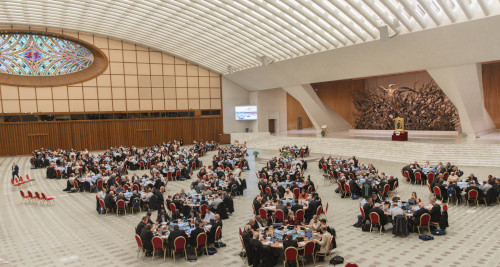
We are Church - Germany draws a mixed conclusion from the conclusion of the XVI Ordinary General Assembly of the Synod of Bishops, on whose final document will be voted today, and calls for genuine and concrete synodality at all levels of the church.
With the synodal process with worldwide participation, including at the grassroots level of the church, Pope Francis has made a church-historical turnaround that builds on the baptismal dignity of all, will have a long-term effect and be irreversible. But even at this second session, it has not yet been possible to resolve the clear contradiction between the early Christian message of the equality of all believers (‘Equality’) and the current dogmatically entrenched church power structure. This applies particularly to the exclusion of women, who had a central role in the early church, from all ordained ministries.
Unresolved ‘women's issue’ shows the power problem of the men's church
The worldwide exposure of the spiritual and sexual abuse of power and its cover-up has led the Catholic Church into a deep existential crisis. However, the Roman Catholic Church is also in a constitutional crisis because, after the Second Vatican Council, the right of the episcopate was overemphasised and the right of the people of the church was underemphasised and women's rights are not recognised. The Catholic Church's traditional Christian view of humanity is no longer convincing either. It will not be enough to strengthen the role of women only within the existing canon law if only men continue to define the role of women.
The highly non-transparent approach of the Pope and the new Prefect of the Dicastery for the Doctrine of the Faith, Cardinal Víctor Manuel Fernández, to the ‘women's issue’ is unsynodal and has lost a great deal of trust, but has also triggered strong opposition. The continuing discrimination against women shows how little respect there is for the baptismal dignity of women and how the traditional, male-dominated power structures are being held on to instead. The legacies of the previous Popes, ‘Inter Insignores’ (1976), ‘Mulieris dignitatem’ (1988) and ‘Ordinatio Sacerdotalis’ (1994), still weigh heavily on the Church today.
From now on, synodality must be practised in a concrete way at all levels of the Church!
For the synod members, the two assemblies in Rome were an intensive learning process, which must now be courageously implemented in Rome and in the individual local churches and later also evaluated.
From now on, the investigation and prevention of sexualised violence must be made a ‘matter for the boss’ everywhere.
From now on, the churchgoers are to be responsibly involved in all essential decisions at the respective levels. Transparency and accountability apply not only to the Pope, but to all believers.
From now on, synodal structures are to be created at the country and continental level, as is already successfully practised in Latin America and Asia. Here, Europe in particular has a lot of catching up to do.
From now on, decentralised solutions are to be allowed in all pastoral matters that correspond to the respective cultural context and are indispensable for an inculturation of the faith.
From now on, the Roman study groups must incorporate the current state of theological research in a transparent manner and include current pastoral requirements.
From now on, the synodal path in Germany, which has been given a tailwind by the deliberations in Rome, must be continued unabated.
From now on, the diaconal work of the church in following Jesus must be brought to the centre. This concerns everyone, men and women.
From now on, the church must not only concern itself with itself. It must change because it has a mission in the world (cf. Council Decree ‘Gaudium et Spes’).
Second Council session on 16 November 2024 in Stuttgart
We Are Church - Germany has critically followed the synodal path in Germany as well as the worldwide synodal process from the beginning. We Are Church - Germany sees it as a success that the reform issues formulated in Austria after the 1995 abuse scandal in Vienna around Cardinal Hans Hermann Groër – participation, women's ministries, exemption of celibacy and sex education – are now finally being openly discussed in Germany and Rome.
-
‘Time is running out! The success of the World Synod now depends on the local churches!’
We are Church 100 days after the final document of the World Synod in Rome (= 3 February 2025)
Press release, Munich, 23 January 2025
100 days after the final document of the second plenary assembly of the World Synod has been approved in Rome on 26 October 2024 by a large majority of all participants and immediately put into effect by Pope Francis, the reform movement We Are Church is once again calling for the rapid implementation of urgently needed reforms in the local churches. Time is running out! The success of the World Synod now depends on the local churches!
If the promising momentum of the two synods in Rome in 2023 and 2024 is not to fizzle out, concrete reform steps must now be taken at the local church level very soon. For in section 94 of the final document of the World Synod, it explicitly states: ‘Without concrete short-term changes, the vision of a synodal church will lack credibility, and this will alienate those members of the people of God who have drawn strength and hope from the synodal path. The local churches must find ways to implement these changes.’ On 25 November 2024, Pope Francis explicitly confirmed the final document of the World Synod again in a ‘Nota’ as part of the ordinary teaching authority.
The How: Discussing and Implementing Reforms
The World Synod first defined the framework for how a synodal church should be designed in order to meet the goal of ‘community, participation and mission’ (the title of the synod). With this synod, Pope Francis has made a significant contribution to church history, one that builds on the baptismal dignity of all church members.
From now on, the entire church community is to be involved in all essential decisions at the respective levels, and not only in an advisory capacity.
For the bishops, transparency and accountability apply not only to the Pope, but to all believers.
For Germany, the decisions of the World Synod provide a strong tailwind with regard to the synodal committee, because the Pope has issued a doctrinal mandate to establish committees at all levels of the Church for participation and co-decision. This means more than just being heard.
The four of the 27 German bishops (Woelki, Voderholzer, Oster, Hanke) have thus been deprived of the basis for their refusal of the synodal committee and its financing.
The what: contextually developing and implementing specific reforms
The World Synod addressed many reform issues, i.e. what needs to be reformed, but important issues were deferred, not yet specifically regulated or left open. This has bitterly disappointed many people around the world who had already expected concrete decisions.
What did not happen at the World Synod must now be tackled all the more urgently in Germany in synodal cooperation between bishops and ‘lay people’ without delay and with determination.
What does not require the approval of Rome can and should be implemented by the bishops immediately in their dioceses. Time is of the essence.
But canon law will also have to change. This has already been addressed in the final document.
With regard to the ten working groups into which the Pope has outsourced topics from the World Synod, We Are Church calls for their results to be published transparently before the end of 2025 and for their implementation to be carried out in a synodal manner, i.e. with the involvement of the local churches.
Transparency and comparability of implementation
We Are Church considers it imperative that church leaders immediately and clearly inform the church base about the results of the World Synod and the further steps towards reform at the local level.
Successful implementations of church action (‘best practices’) should be published as examples for other dioceses. In particular, the elected committees, such as priests and diocesan councils, should contribute to this. The pressure of expectation for concrete results is rightly high. Whether the church will regain public reputation depends on concrete action.
The research on the internet and in the German dioceses, carried out by Wir sind Kirche together with the parish initiative, has so far only partially yielded further results. The research covered information, actions, events, (new) committees and statements by the local bishops after the end of the World Synod.
Link to the updated evaluation
Reforms can only succeed together
The German bishops and committees should join forces with other local churches in Europe if they want to be heard in the Vatican.
Isolated proposals from Germany have so far not been taken into account in Rome. Only together can they succeed in countering the massive loss of credibility caused by abuse, cover-ups and the backlog of reforms. The further actions of the archbishops and bishops in Germany are to be measured by the participation of the entire church people as well as by the transparency and accountability of the bishops.
Press contact:
Paul-G. Ulbrich (We Are Church / Parish Initiative)
Tel. 0157-8845561, E-Mail:This email address is being protected from spambots. You need JavaScript enabled to view it. Konrad Mundo (We Are Church Federal Team)
Tel. 030-5433982, E-Mail:This email address is being protected from spambots. You need JavaScript enabled to view it. Christian Weisner (We Are Church team)
Tel. 0172-5185082, E-Mail:This email address is being protected from spambots. You need JavaScript enabled to view it. More on synodality: www.wir-sind-kirche.de/synodalitaet
-
"Bread, Not Stones"
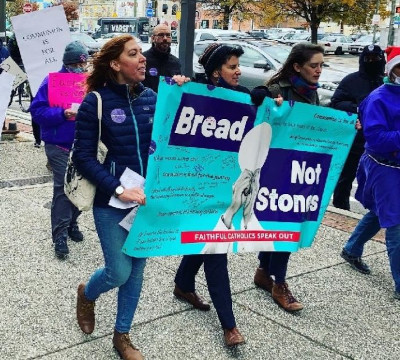
The Women's Ordination Conference and our partners in church reform gathered on Monday in Baltimore for a prayerful witness calling for "Bread, Not Stones," ahead of the US bishops' conference meeting where they were to vote on a controversial document on the Eucharist. Just about 50 of us where there, praying, marching, chanting, and singing, as the US Bishops met behind closed doors.
WOC led the way as we carried our message of inclusion to the hotel where the bishops were meeting, encountering aggressive hecklers along the way. We stood courageously and firmly in our faith that teaches us that it is wrong to weaponize the Eucharist, and that there were no orthodoxy tests at Jesus’ table.
; -
"Exclusion of women from ordination cannot be justified biblically".
"Exclusion of women from ordination cannot be justified biblically".We are Church Germany Press Release on the ordination of presbyters in Cologne on 16 June 2023
On this year's Solemnity of the Sacred Heart of Jesus, Friday 16 June 2023, Archbishop Rainer Maria Cardinal Woelki of Cologne will ordain six deacons as presbyters in Cologne Cathedral. This demonstrates once again, without any biblical basis, that women are being denied ordination to the presbyterate solely for the sake of clerical male power.
The Church People's Movement We Are Church recalls the ordination of seven women presbyters 21 years ago on 29 June 2002, the feast of the holy apostles Peter and Paul, a date on which many ordinations usually take place.
While Pope John XXIII (1958-1963) in his encyclicals "Mater et magistra" (15 May 1961) and "Pacem in terris" (11 April 1963) spoke out for the equal human rights also of women in all spheres, Pope John Paul II in his letter "Ordinatio Sacerdotalis" (22 May 1994) attempted to establish the prohibition of women's ordination for all time and thus gave his successors a heavy burden.
We are Church welcomes the fact that despite this ban, the discussion about the renewal of the presbyterial ministry and its opening to women has not ceased but has intensified and has now also been underpinned with good theological arguments at the Synodal Path in Germany. In the meantime, more and more bishops in Germany and worldwide no longer consider the ordination of women to be impossible.
For it is and remains a scandal that the Roman Catholic Church still denies women ordination for leadership ministry. This fundamental degradation of women, which cannot be justified biblically and theologically, poses the danger that the Church will very soon no longer be able to fulfil its pastoral mission.
Preview of the year 2040: reality or still a vision?
Compulsory celibacy for secular clergy has been abolished. Four of the six deacons ordained in 2023 are married - two of them long-time happy fathers. In an interview, the new pastor of Unkel emphasises that his wife is already a deacon and is currently preparing for ordination to the presbyterium. They write their sermons together, which are very appealing to people.
The shortage of presbyters is a thing of the past and the understanding of ministry has changed. Now competent laymen and laywomen have taken over parish leadership and administration. Presbyters, deacons and deaconesses can finally concentrate on their core tasks: Pastoral care, church services and life-accompanying chapels. This has made it possible to guarantee sufficient "supply" everywhere again; long journeys to Mass are a thing of the past.
The chaos caused by the areas of mission decreed from above with a minimal supply of presbyters (one presbyter for nine and more parishes, which overtaxed everyone) is, thank God, a thing of the past. Overall, the role of the laity has been enhanced, as the Second Vatican Council (1962-65) wanted. They have more say at all levels, which has led to an upswing in congregational life. Joint communion celebrations with the Protestant Church are still not officially "allowed", but are celebrated almost everywhere. Divorced, remarried or homosexual people are no longer excluded from communion.
Decisive for the smashing of the argument that Jesus only called men were the continuous protests of many Christians and also of We are Church and Maria 2.0. Their argument: The demand for human and women's rights, which Pope John XXIII started with, is already manifested in the Bible (Genesis 1, 27): God created man in his image... as male and female he created them!
We are Church press contact:
Georg Mollberg (We are Church in the Archdiocese of Cologne).
Tel: 02224 3960, e-mail:This email address is being protected from spambots. You need JavaScript enabled to view it. Christian Weisner (We are Church national team)
Tel: 0172 5184082, e-mail:This email address is being protected from spambots. You need JavaScript enabled to view it.
-
"Trumpet of Jericho" awarded to Josef Pampalk
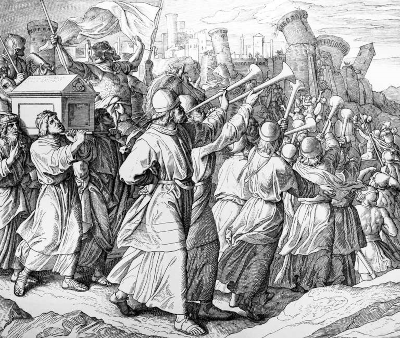
 The Trumpet of Jericho is a prize for special services to the reform of the Catholic Church. The award goes to people who stand up against outdated church rules. Especially people who have been punished for this by the church leadership are worthy of the award, for example by losing their job or limiting their career.
After the successful first presentation of the trumpet by Jericho to Doris Reisinger in October 2021, this year’s winner is Josef Pampalk, political scientist and Afrikanist. As a former missionary of the White Fathers in Mozambique, he witnessed how the bishops there submitted to the colonial power of Portugal. A 1940 concordat between Salazar and the Vatican decreed that the missions were considered an agency in the service of the Portuguese Empire, that the colonial government selected and paid the bishops, They expected clear support in maintaining colonialism. Those who criticized or stood up for the rights of the locals were punished or expelled from the country. When the White Fathers decided to protest, they were expelled from Mozambique in 1971. The Vatican’s support for colonialism led to the resignation of Pampalk and other "White Fathers".
This award cerenibt will take place on Friday 7 October 2022, 18:00-20:30 at 1010 Vienna, ÖJAB-Haus Johannesgasse 8, Vivaldi-Saal
Read the invitation Invitation - Program:
Ewald Benes: Why this award was created
Margit Hauft: The decision of the prize committee
Paul Zulehner: Mission today - learning from mistakes - Tasks of the Church
Eric Morier-Genoud: History of the Roman Catholic Church in Mozambique
Rudolf Mayerhofer-Sebera: Laudation: Meaning and purpose of this nomination
Presentation of the prize
Josef Pampalk: Thanksgiving and message from the recipientPress contact: Ewald Benes,
This email address is being protected from spambots. You need JavaScript enabled to view it. +43 664 125 0001 -
“Human Rights in the Catholic Church” Event to Coincide with International Synod in Rome
Spirit Unbounded, a global community of Catholic reform and other Christian and ecumenical networks that share a vision of a just and inclusive church, presents “Human Rights in the Catholic Church,” a weeklong event coinciding with the 16th Ordinary General Assembly of the Synod of Bishops in Rome in October.
The Spirit Unbounded event will take place from 8–14 October 2023 and will feature both live and prerecorded digital presentations. Presentations from 8–12 October will be streamed online, with live and prerecorded presentations on 13–14 October. Gathering spaces in Bristol (UK) and Rome will allow people to attend the event in person.
Keynote speakers Sr. Joan Chittister (USA), Dr. Mary McAleese (Ireland), and Steven Newcomb (Shawnee-Lenape author and scholar) head an expanding international roster with over 70 speakers to date. Presenters include activists, artists, and storytellers alongside academics and theologians. Spirit Unbounded is aiming to represent the diversity of the global church at the event, particularly Indigenous communities and presenters from Central and South America, Africa, the Middle East, and Asia. Speakers will address the theme of human rights in the Catholic Church, particularly how the church can move beyond clericalism to better model human rights both within and outside the institution.
Conceived as having “the ambience of a festival rather than a conference,” the event will highlight spiritual, theological, practical, doctrinal, and creative ways to reimagine authority and ministry, re-think ethical questions through the primacy of conscience, and renew a commitment to care for our neighbor and our environment. By linking the principles of justice, equality, and mercy to concrete actions, the event will enhance the synodal journey toward a more Christ-centered church. Additionally, it will offer participants from all over the world an opportunity to connect, share their hopes, and expand a network of reform-minded organizations that will endure beyond the official close of the Synod in 2024.
For all event information, including ticketing for both digital and in-person events and accommodation packages, please see the Spirit Unbounded event page here.
###
Additional Resources
1. Spirit Unbounded website: https://spiritunbounded.org
2. Event page: https://spiritunbounded.org/event
3. List of confirmed speakers as of 26 June 2023: https://docs.google.com/document/d/1b0QGyKO9bMMBaWuyj47GTX2Gcbln9hM3/edit?usp=sharing&ouid=110777516573974247447&rtpof=true&sd=true
4. Direct link to event ticketing: https://www.gr8events.ie/sales/index.php?event=1361
5. Mailing list signup: https://spiritunbounded.org/subscribe
Social Media
2. Twitter: https://twitter.com/SpiritUnbounded
3. Instagram: https://www.instagram.com/spiritunbounded_itl/
Contact Information
1. Media and interview requests:
This email address is being protected from spambots. You need JavaScript enabled to view it. 2. General inquiries:
This email address is being protected from spambots. You need JavaScript enabled to view it. -
“Pope Francis' reform process already changed our Church”

Pope Francis' reform process has already changed our Church, We are Church International says after observing and accompanying the first half of the 2023 Synod in Rome. The presence of voting members who are not bishops, half of them women, changed the climate fundamentally as well as the round tables that visualise a new type of non-hierarchical communication inside the church. We are Church International has asked for the inclusion of the laity from the very beginning and this certainly has to be extended.
The task for the eleven months until the Synod in October 2024 is clear: Within its own network and together with other reform networks present in Rome, We are Church International will foster the reform spirit that has become visible inside and outside the Synod hall in many private talks and meetings with members of the Synod. In this climate of trust the Church’s traditional teaching on the questions of leadership, women’s equality, inclusion of minority groups and other issues were addressed by many local churches all over the world.
The recent disclosures of spiritual and sexualised violence in Switzerland and France has already shaken the church in many countries. We are Church International hope that the Synod finally will address the root causes of spiritual and sexual abuse that so deeply continue to destroy the credibility of our church.
Supporting the positive spirit in Rome demands that the Synod address fundamental problems like misuse of clerical power, subordination of women and outdated sexual doctrine.
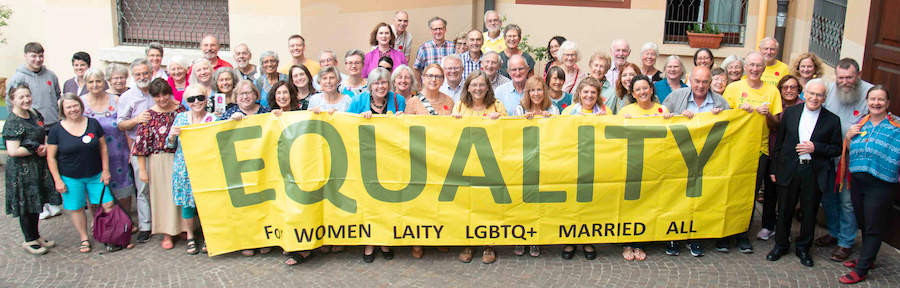
“Equality for all” was the goal of a vigil in the evening of October 12th with more than 30 persons from 13 countries on St Peter’s Square. On October 13th and 14th the weeklong conference “Human Rights in the Emerging Catholic Church”, organised by Spirit Unbounded and strongly supported by We are Church International, gave very clear insights into the challenges of the Roman Catholic Church today to help the church be a convincing witness of the gospel. Sr Joan Chittister OSB and the former Irish president Mary McAleese together with more than 110 speakers from all continents gave hope for the excluded at this lay-led synodal assembly coinciding with the official Synod in Rome. Website: https://spiritunbounded.org/
On October 15th and 16th, 2023 We are Church International held its biennial conference “Equality for all” in Casa Bonus Pastor in Rome. 27 delegates present in Rome and 5 who joined virtually elected a new coordinating team for We are Church International: Christiane Bascou (France), Dr Martha Heizer (Austria), Colm Holmes (Ireland), Jamie Manson (United States), Mary Morrissey (Ireland), Ashik Naz Khokhar (Pakistan), Jean Pierre Schmitz (France), Dr Martin Schockenhoff (Germany), Ed Schreurs (Netherlands), Valerie Stroud (United Kingdom).
Media contact:
Colm Holmes, Dublin/Ireland, Chair We are Church International
Email:This email address is being protected from spambots. You need JavaScript enabled to view it. Phone: +353 86606 3636Dr Martha Heizer, Innsbruck/Austria, Vice-Chair We are Church International
Email:This email address is being protected from spambots. You need JavaScript enabled to view it. Phone: +43 650 4168500 -
“Reforms must go further and deeper!”
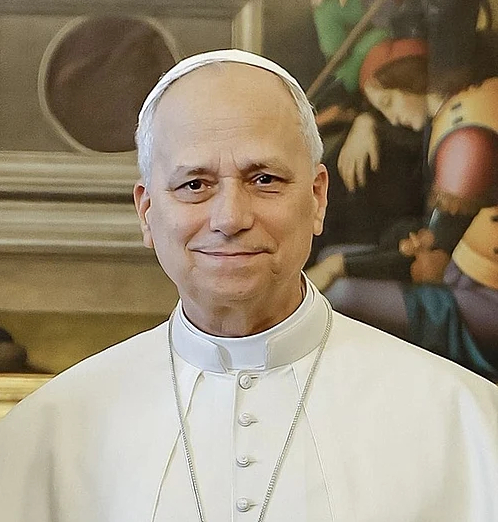
A critical assessment by We Are Church on the first anniversary of the election of Pope Leo XIV
Press release, Munich, Innsbruck, Rome, May 7, 2026
The We Are Church movement in Germany and the We Are Church Platform in Austria drew a nuanced conclusion at the end of Pope Leo XIV's first year in office. With his focus on peace from the very first day, culminating in his recent, very clear pronouncements against all warmongers, including US policy, as well as his messages during his trip to Africa, Pope Leo has given his pontificate and the papacy a strong profile in this first year. Leo's efforts toward peace and cooperation in world politics are rightly widely recognized and offer hope in light of the global crises. It will be considerably more difficult for him to shape peace and unity within the worldwide Roman Catholic Church in a sustainable way.
Programmatic Legacy
As a wise, worldly, and experienced religious, Pope Leo continues with and implements what his charismatic predecessor Francis rightly stirred up and unleashed. With the much too little-noticed document "Dilexi te," Leo has taken over and further developed the programmatic legacy of his predecessor's "preferential option for the poor." It is Francis's missionary course that solidifies action for and with the poor of all kinds as a central message of the Christian faith. This document of continuity between Francis and Leo praises the reinterpretation of Christian revelation in the context of modern social, labor, economic, and cultural conditions, which is inconceivable without the laity. We Are Church sees "Dilexi te" as a suitable foundation for the many pending and synodally required decisions on direction facing the entire Roman Catholic Church, indeed, all of humanity.
Global Cultural and Leadership Experience
Unlike the charismatic disruptor Francis, the more reserved and unassuming Leo XIV, whom he groomed as his successor, is a team player with global cultural and leadership experience. Leo XIV seeks consultation and involves the Vatican and the cardinals through regular consistories. This approach is more sustainable, but unfortunately, it can also slow down urgently needed reforms. However, it is essential to quickly end misunderstood traditions based on power and outdated anthropological perspectives, such as those found in the teachings of Augustine, the founder of his order.
Some concrete areas for action
Just as Pope Leo XII advocates with due clarity for human dignity and human rights—for example, those of the marginalized and refugees—he must also be judged by how human rights are implemented within his own Church under his leadership. Some of his statements to date therefore invite contradiction.
Clericalism
With the statement that the hierarchical order of the Church is not man-made, or with the washing of feet on Holy Thursday only by priests, Leo may be hoping to appease the insecure male clergy. However, this can and must be countered with sound theological arguments in no uncertain terms. It is necessary to overcome clericalism, which is based on flawed metaphysical and theological foundations, with its problematic view of women and the denial of internal Church democracy at all levels. The requirement of celibacy must be reviewed.
The Women's Question
His evasive statements regarding the ordination of women have caused great disappointment, particularly in Western cultures. The Synod has shown that the "women's question" is relevant worldwide. The published final report of Study Group 5, "Women," of the Synod clearly demonstrates that there are now differing positions on this issue, even within theology. It is noteworthy that Pope Leo X sees cultural, rather than theological, obstacles to the ordination of women. This opens up possibilities and compels action. After all, the Catholic Church is arguably the largest educational institution in the world, and Leo places great emphasis on education and training. Through genuine equality for women at all levels, the Catholic Church could, indeed should, be a pioneer in fundamentally improving the situation of women worldwide.
Synodality
Crucial for the future of the Church is not only the continuation of the synodal process initiated by Pope Francis, but also genuine synodality and participation on equal terms. That Pope Leo XIV, as a cardinal, actively participated in the synodal assemblies and has now pledged their continuation is a first step, but one that is insufficient. Crucial is the transformation of the synodal process into genuine synodality at all levels of the Church, with binding participation and shared responsibility for the laity, as well as accountability for bishops and those in positions of responsibility within the Church. Decisions made jointly by laity and bishops must be morally and legally binding for the clergy. A purely advisory role is inadequate. Without a corresponding, timely adaptation of canon law, genuine pastoral, structural, and magisterial reforms remain illusory.
Sexual and Spiritual Abuse
Sexual and spiritual abuse, which has shaken the credibility of the Catholic Church for decades, was clearly addressed by Pope Leo at his first consistency. In many countries, this issue is still ignored or downplayed. As with the Synodal Path in Germany, there is no alternative to demanding decisive action from church leaders worldwide and addressing the systemic causes of abuse of power, violence, and cover-ups.
Sexual Morality and Blessing Ceremonies
The recent reaffirmation by the Pope and the Vatican of the rejection of blessing ceremonies decided upon by the Synodal Path and individual bishops in Germany is not only disappointing but also rejects culturally appropriate developments. We welcome the fact that Pope Leo XIV does not see a disagreement on sexual morality as grounds for a schism in the Church and considers other “issues of justice” more important to him. But the Church must face reality: A sexual morality that excludes millions of believers and denies their lived reality is unbeatable in light of Jesus' all-encompassing commandment of love. As long as doctrines are clung to that ignore the findings of modern human sciences and marginalize people, any talk of unity is an empty promise and lacks credibility.
Traditionalists
Leo rightly sees the danger that the controversy surrounding the "Old Mass" is being exploited to impose pre-conciliar theology. "We Are Church" strongly warns against accommodating the Society of St. Pius X, which already deceived his predecessor, and other divisive movements in any way. Unity must also have its limits.
First Encyclical
The first encyclical, "Magnifica humanitas," by Pope Leo XIV, announced for May 15, 2026 (exactly 135 years to the day after Leo However, the Catholic Church must also be measured against the standards it sets, for example, against the principle of subsidiarity formulated in "Quadragesimo Anno" in 1931, which emphasizes the important decentralization and regionalization of responsibilities.
Press contacts for Wir sind Kirche Germany:
Sigrid Grabmeier, Tel: +49 170 86 26 290, E-Mail:
This email address is being protected from spambots. You need JavaScript enabled to view it. ;
Konrad Mundo, Tel: +49 30 5433982, E-Mail:This email address is being protected from spambots. You need JavaScript enabled to view it. ;
Christoph Schomer, Tel: +49 177 764 80 94, E-Mail:This email address is being protected from spambots. You need JavaScript enabled to view it. ;
Christian Weisner, Tel: +49 172 518 40 82, E-Mail:This email address is being protected from spambots. You need JavaScript enabled to view it. Press contacts for Wir sind Kirche Austria:
Dr. Martha Heizer, Tel: +43 650 4168500, E-Mail:
This email address is being protected from spambots. You need JavaScript enabled to view it. -
3 days in the countryside in Indonesia
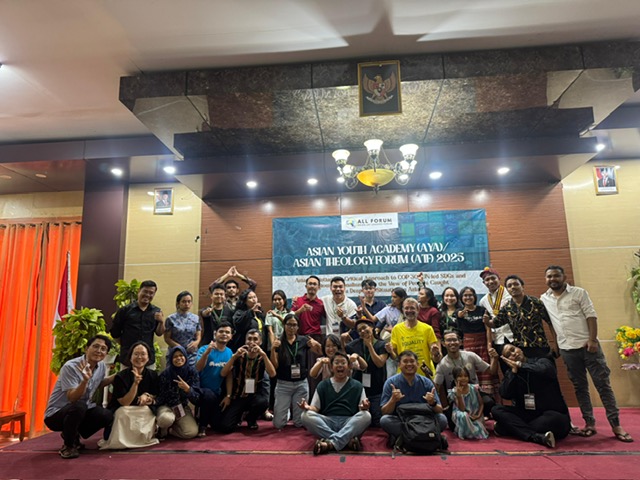
Asian Lay Leaders Forum (ALL Forum) 2025
As part of the forum, participants spend three days with local people
17 August 2025
In the morning, eight of us drive to an indigenous village about 64 km outside of Yogyakarta. The last few kilometres are quite a bumpy ride. There are 40 adults and 53 children living here.
We are greeted by two village elders and several men. Many women also come to greet us and shake our hands, but there are only men in the meeting room. The two elders explain the village community in Indonesian; an Indonesian translates into English. Afterwards, there is a communal lunch, which has been cooked by the women. The women do not take part in the communal meal, but they enter the common room afterwards and also take part in the conversation.
There are no tables or chairs. Everything takes place on the floor. Cooking is also done on the floor, over an open fire. We get to pound rice. There is a longer break after the meal. We talk to the women and children.
The children are curious and sociable. Before long, two girls around twelve years old begin to dance, with music playing from a smartphone while the other children chuckle and laugh.
Towards evening there is another round of discussion, followed by a short liturgy and then dinner. After dinner, there is a general round of introductions in which the women also take part.
After the introductions, we head out onto the covered terrace, where a relaxed conversation quickly develops. Someone suggests that the guests should sing. The participants from Laos, Vietnam, Malaysia, the Philippines and Indonesia can really sing. In the case of a few songs that are obviously well-known, everyone sings along. The mood is exuberant. You don’t need language to communicate!
The people here believe in a creator God who created the world and its people. They practice monogamy and divorce is possible. Many of them work on a farm outside the village. They also depend on goats and chickens to help meet their needs.
We spend the night in the village in a separate room that a family has obviously temporarily vacated for us. The sanitary facilities are very basic, and we sleep on mattresses on the floor.
18 August 2025
When I wake up in the morning, the children and the woman of the house are walking through our bedroom as if we aren’t even there. After breakfast, they move at a leisurely pace – why rush? Suddenly, an army officer appears with an escort. He wants to see our passports. We are confused at first, then gradually amused. The army officer seems to have plenty of time. He accepts a cup of tea and has a long chat with one of the elders while smoking. Finally, we also sit down with them and listen to various stories from the officer about the small border traffic between Malaysia and Indonesia on Kalimantan (formerly Borneo), where he was stationed for several years.
Afterwards, the village elder apologises to us repeatedly, saying this has never happened before. He probably assumes that we might have been confused or even intimidated by the unannounced visit. But the answer to our question about the reason for the visit is somewhat vague. Ultimately, it seems that the army is quite interested in who comes to the indigenous village and what ideas they bring with them.
We play the card game Uno or volleyball with the children. In the kitchen, we are allowed to help prepare a typical local grain-based dish.
There are brief rain showers, as it is the rainy season.
I have a long chat with Doo, a participant who comes from Laos and was a Buddhist monk for eight years. He tells me about the ascetic lifestyle of Buddhist monks (waking at 5 a.m. in summer and 2 a.m. in winter). During their training, the monks have to memorize a great deal and even walk 1,000 km barefoot at one point. The day is very structured, similar to in a Cistercian monastery.
In the afternoon people drink tea, smoke and talk. Many of the men smoke, but none of the women do. I don’t see a television screen or antenna in the village, but there is electricity. Running water is only available from a tap in the toilet, which also serves as the bathroom. Water comes from plastic bottles or is collected from the rain; otherwise, no plastic packaging is visible.
All the food is freshly prepared from rice and what is grown in the village. Bananas and peanuts are always included, and sometimes chicken. I haven’t seen a refrigerator
My questions about village organisation, property ownership and children’s school attendance are only partially answered, which may be because I ask my question to an Indonesian participant, who translates it and then translates the answer back for me. In any case, there is private property: the houses belong to individual families, but the families have to contribute to communal tasks.
At mealtimes, the separation is not as strict as it was the previous day. Women and children are present at lunch. During dinner, the women initially stay outside but then come in and mingle with us.
After dinner, our hosts sing religious songs from their songbook (stapled together from photocopies). An Indonesian explains the meaning of the songs to us. A song is usually sung by a lead singer, sometimes alternating with the entire congregation. There are also songs interspersed with short spoken verses. Words of thanks are then exchanged. Our hosts apologise for the modest conditions here, for the embarrassing visit by the military, and thank us for coming. We also express our thanks at length. The exchanges of thanks, answers, and questions take about an hour, but the mood in the room remains relaxed.
19 August 2025
Life in the village moves at a leisurely pace. The women are in the kitchen preparing breakfast. Two or three people could manage it on their own, but efficiency is not a priority here. What else should the other women do during this time? This also has to do with communication. The kitchen is a communal kitchen where food is cooked for the entire village. However, not everyone always eats together. The families usually take the food into their own homes. Our visit is clearly an exception, as many men, women and children eat together with us.
The men sit on the terrace, drinking tea and smoking; some chat, while others remain silent. The Indonesian participants speak with them from time to time.
Then comes the farewell. Our hosts are in tears. Women and men hug us and give us food to last at least two days. Photos are taken in different group combinations. Then it rains again. We get into the car and leave.
-
A Baptism of Hope in a Climate of Fear: Little Eva’s First Sacrament in Pakistan
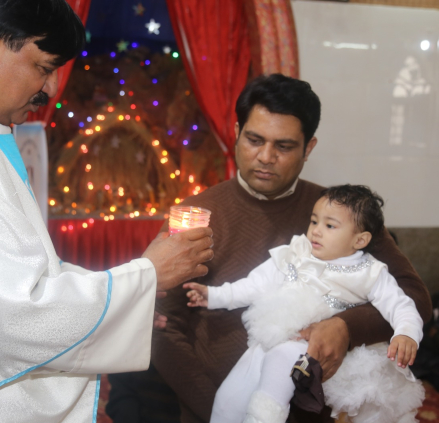
We Are Church rejoices and sends congratulations and good wishes to Eva and her family
In the heart of Sahiwal, at Sacred Heart Church, a small but deeply meaningful event took place: little Eva received her first sacrament of Baptism. For her parents, Mehwish and Ashknaz, the ceremony was not only a spiritual milestone but also an act of courage and hope in a society where religious freedom for minorities remains fragile and constantly under threat.

Pakistan’s Christian community, along with Hindu and other religious minorities, lives under continuous pressure from social prejudice, religious extremism, and institutional neglect. Reports from human rights organizations consistently highlight forced conversions of minor girls, rising child marriages, lack of access to proper healthcare for minority women, and the widespread misuse of blasphemy laws. These realities have repeatedly led to mob violence, attacks on churches and homes, and deep psychological scars within vulnerable communities.
Against this backdrop, Eva’s baptism stands as a quiet declaration of faith and resilience. Mehwish and Ashknaz expressed immense joy as their daughter was welcomed into the Christian faith, yet their happiness is inseparable from concern for the world she will grow up in. They long for a Pakistan where Eva can practice her faith freely, feel protected by the state, and live without constant fear of discrimination or hostility.
They also dream of a Church that truly embodies equality, justice, participation, and service. A Church where the laity has an active role, a meaningful voice, and shared responsibility in decision making alongside the clergy. A Church that listens to its people, addresses social injustice, and works tirelessly for the welfare of its parishioners and the wider society.

Central to this vision is the urgent need to protect and promote education for girls. In a country where extremist violence once targeted Malala Yousafzai (Nobel Winner) simply for demanding the right to education, the message is clear: educating girls is both a moral duty and a powerful act of resistance. The Catholic community, in particular, must share responsibility for ensuring that young girls, especially those from families lacking financial means, receive quality education. We must come forward with support, scholarships, school access, and resources so that no Catholic girl is denied her future.
Little Eva’s baptism is more than a family celebration. It is a symbol of hope, resilience, and commitment to building a more just Pakistan where every child, regardless of religion or gender, can grow with dignity, security, and opportunity.
For Mehwish and Ashknaz, the baptism of their daughter is the beginning of that promise.
Email:
This email address is being protected from spambots. You need JavaScript enabled to view it. -
A bitter setback for the reappraisal and all reforms
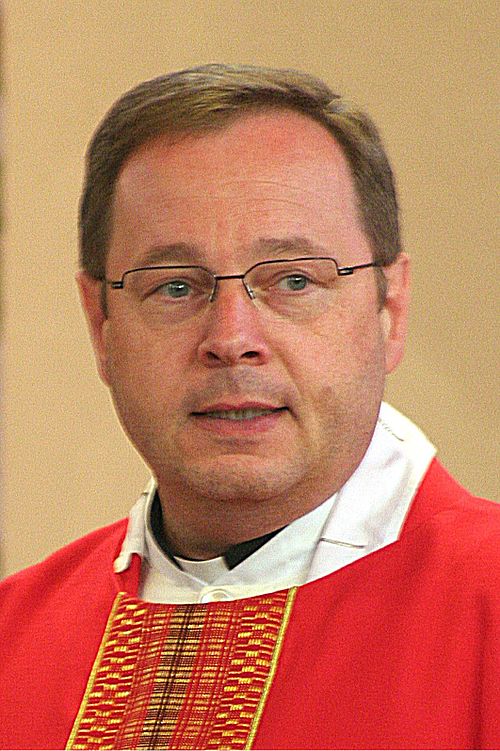
We are Church-Germany on Bishop Bätzing's resignation from his second term as DBK chairman
Press release, Munich, Bonn, January 20, 2026
We are Church It deeply regrets that, given the balance of power within the German Bishops' Conference (DBK), Bishop Dr. Georg Bätzing feels compelled to resign from a second term of office. We are Church considers this a severe setback for the painstakingly begun investigation of sexualized violence, for all upcoming reforms in the Roman Catholic Church in Germany and especially for the urgently needed reforms that were decided upon in the Synodal Path. We are Church fears that this will accelerate the Church's path to social insignificance.
Starting point MHG study
It should be remembered again and again: After the shocking results of the abuse study commissioned by the German Bishops' Conference, the MHG study, published in 2018, it was the German bishops who, under their then chairman, the Munich Cardinal Reinhard Marx, approached the Central Committee of German Catholics in order to jointly find an answer to the deep church crisis through the –albeit canonically non-binding – „Synodal Path“. The stated aim was to address the systemic causes of sexualized violence and its cover-up through the four synodal forums „power, priests, women and sexuality“.
Under the DBK chairman Bishop Dr. Georg Bätzing, elected in March 2020, the Synodal Path has, despite all internal and external difficulties, developed essential, fundamental and action-oriented reform steps that are also receiving worldwide attention, as well as at the level of the worldwide Synodal Process begun by Pope Francis in 2021. At least the decisions of the Synodal Path to date must be consistently implemented in as many dioceses as possible in order to promote genuine synodality at the grassroots level.
Most difficult framework conditions
But it is a tragedy how the traditionalist divisive forces within the German bishops managed to slow down the Synodal Path from the beginning, block further work in the Synodal Committee, and now use their blocking minority to prevent Bishop Bätzing from being re-elected. The role of the Papal Nuncio, Archbishop Nikola Eterović, who was still chosen by Pope Benedict and who has blocked any understanding between the Vatican and the Catholic Church in Germany over the past twelve years, is also extremely unpleasant. The weak position under canon law of the General Assembly of the German Bishops' Conference, which requires unanimous decisions, as well as the desired independence of each individual bishop ultimately lead to a catastrophic external image of the entire church leadership.
Recognition for Bishop Bätzing (updated)
We are Church thanks Bishop Georg Bätzing for his great commitment to advancing the arduous but urgently needed investigation of sexualized violence as DBK chairman. The „Synodal Way“ was his „passion project“ and more lay participation in decisions was very important to him. He advocated for the upcoming pastoral reforms, some of which - such as the women's diaconate - have been under discussion since the Würzburg Synod (1971-1975). Despite resistance from a minority within his own ranks and from Rome, he acted competently, openly and purposefully as a bridge builder and thus also influenced the church's public reputation in a positive way.
Press contact We are Church - Germany
Konrad Mundo (national team), email:
This email address is being protected from spambots. You need JavaScript enabled to view it. , Tel: 030 5433982
Dr. Martin Schockenhoff, email:This email address is being protected from spambots. You need JavaScript enabled to view it. , Tel: 0173 324891
Christian Weisner (national team), email:This email address is being protected from spambots. You need JavaScript enabled to view it. , Tel: 0172 518 4082First opinion of We are Church - Germany on January 19, 2026
We are extremely sorry to the Church for Bishop Dr. Georg Bätzing's waiver of a second term of office. This is a bitter setback for all the upcoming reforms in the Catholic Church in Germany and especially for the urgently needed reforms of the Synodal Path. It is to be feared that this will further accelerate the Church's path to social insignificance.
Press Contact We are Church - Germany Federal Team
Christian Weisner, Email:
This email address is being protected from spambots. You need JavaScript enabled to view it. , Tel: 0172 518 4082Other voices on the announcement by Bishop Bätzing
kfd on Bishop Bätzing's decision: Respect and thanks for committed commitment in the Synodal Path
Philipp Gessler: "Too big" Why Bishop Georg Bätzing is no longer running as chairman of the German Bishops' Conference
With thanks to https://www.wir-sind-kirche.de/
-
A CALL TO OPEN-MINDED CHRISTIANS

A CALL TO OPEN-MINDED CHRISTIANS
We, representatives of 30 Christian associations gathered at the General Assembly of Les Réseaux du Parvis around “The spirit of Jesus as an art of living in the world, an inspired humanism,” reaffirm that Jesus practiced an unconditional welcome of all people in his time and that, following his example, we want to live in brotherhood and sisterhood beyond religious, cultural, and social identities.
We therefore call on open-minded Christians, whether or not they are affiliated with institutional Churches, to distance themselves, by whatever means they choose, from the extreme fringe of identity-based Catholicism, which is instrumentalised through massive funding and media campains by the far-right, in its attempt to take over Christianity,
The gospel has nothing to do with such attitudes, being a message of liberation and respect for all, beginning with the least, the excluded, and the strangers :
The gospel belongs neither to those nostalgic for Vatican I nor to Christians in general, but to all of humanity.
In this spirit, we also denounce the excesses and abuses of a Catholic institution in crisis which, despite the recommendations of the CIASE, remains hostage to a sacralized and exclusive tradition and to male power, both of which deny the equality of human beings and crush the “little ones.” The abuses recently uncovered in Catholic educational institutions have the same roots.
In these times of global imbalance, alongside wars, calls for hatred of others, and systems where the law of the strongest prevails, there are other human relationships, paths that create both meaning and life. All these paths, without exception, involve justice, dialogue, and the primacy of human beings, especially the most fragile or the most exploited ones, over finance.
On these open paths, where the spirit of Jesus is one of the vectors of hope, we want to share the history of our common Earth
with all people of good will, for a reconciled humanity.
*
November 30, 2025
- Chevilly-Larue -
PRESS RELEASE from the 2025 General Assembly of « LES RÉSEAUX DU PARVIS »
-
A Charter of Rights and Responsibilities For Christ’s Faithful
Adopted by ICRN in Warsaw September 2019
The Principles for a Charter of fundamental rights and responsibilities for Catholics were articulated by the Ordinary Synod of Bishops in 1971. Its final document was entitled “Justice in the World.” Importantly, the document preserves the remaining core of a larger project commissioned by Paul VI at the conclusion of the Second Vatican Council. It came to be known as the Lex Ecclesiae Fundamentalis (The Basic Law of the Church) and was meant to stand alongside of Paul’s Credo of the People of God. Together they were intended to capture Vatican II’s evangelical vision and mission of the Church and function as the moral principles that would inform the interpretation of Canon Law as well as provide a guide for the life and governance of the Church. Most importantly, the moral foundations of right relationship in the Christian community are grounded in the teaching of Jesus: So, whatever you wish that others do to you, do to them; for this is the Law and the Prophets. (Mt 7: 12). -
A contradictory theologian who leaves behind a difficult legacy
We Are Church International offers prayers for the repose of the soul of the retired Pope Benedict XVI who died on 31 December 2022.We Are Church International sees the late Cardinal Joseph Ratzinger, former Pope Benedict XVI, as a highly contradictory theologian who shaped the Roman Catholic Church for decades in a backward-looking way like no other post-conciliar church leader. He left his successor Pope Francis and the entire Church a difficult legacy to overcome, leaving a climate of fear and a theological standstill.
While Joseph Ratzinger helped shape the reforms of the Second Vatican Council (1962-1965) as a young theologian and advisor, he later proved to be a theologian driven by mistrust and frozen in fear in his 31 years at the Vatican (1982-2005 as Prefect of the Congregation for the Doctrine of the Faith under Pope John Paul II, 2005-2013 as Pope Benedict XVI), who was overwhelmed with his leadership tasks.
Joseph Ratzinger did not develop an understanding of the future dimension of faith. Rather, he tried to limit or even withdraw the reform impulses of the Council. He thus proved to be a relentless reactionary who ultimately failed. During Benedict’s reign, it became more and more obvious that maintaining the Church hierarchical system is totally inconsistent with, if not opposite to, the Gospel’s message. Even as "Papa emeritus" he repeatedly spoke out in a highly problematic manner, despite his promise to the contrary. With his implausible statements on the second Munich abuse report, he himself severely damaged his reputation as a theologian and church leader and as a "co-worker of the truth" (his bishop's motto). He was not prepared to make a personal admission of guilt. In doing so, he did great damage to the episcopal and papal office.
His commendable resignation in 2013 demystified the papal office. It would have been logical, however, if he had also taken off the white cassock.
May he rest in peace.
Colm Holmes
Chair, We Are Church International
EThis email address is being protected from spambots. You need JavaScript enabled to view it.
M +353 86 606 3636 -
A Divine Calling: One Woman’s Life-Long Battle for Equality in the Catholic Church
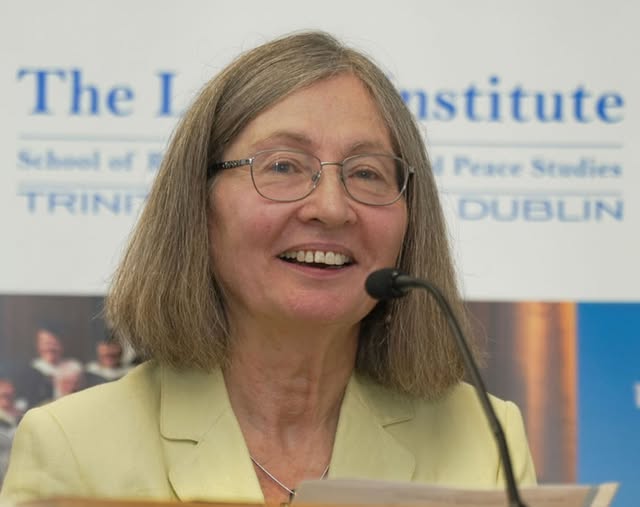
We congratulate Soline Humbert on the launch of her book on 1 October 2025 in Trinity College Dublin.
Speakers at the launch included Michael Kirwan SJ, Phil Dunne (MC), Ursula Halligan, Gerry O'Hanlon SJ and Soline Humbert.
Soline's Memoir is published by The Liffey Press: https://theliffeypress.com/a-divine-calling-one-woman-s-life-long-battle-for-equality-in-the-catholic-church.html
For overseas orders Kennys.ie is good value: https://www.kennys.ie/shop/a-divine-calling-one-woman-s-life-long-battle-for-equality-in-the-catholic-church-soline-humbert-9781068664564-1
-
A Divine Calling: One Woman’s Life-Long Battle for Equality in the Catholic Church
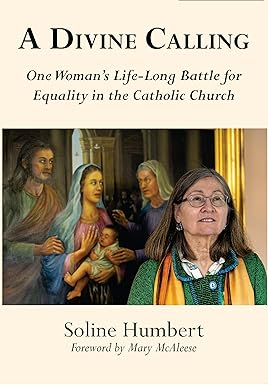
We Are Church supporter, Soline Humbert, invites you to buy her book and journey with her vocation.
As a student in Trinity College Dublin, Soline Humbert experienced a call to the priesthood in the Catholic Church, which she was unable to pursue because of the ban on women’s ordination. She found herself on a collision course with a powerful church hierarchy intent on quashing any such vocation, and was even warned of excommunication if she persisted.
In this ground-breaking memoir, Soline candidly shares her struggles, her dark nights of the soul and her ecstasies, as well as her decades-long effort to bring about an end to women’s exclusion from the priesthood. She is told again and again: ‘The door to women’s ordination was shut and would remain shut.’ And that was that.
But as the Catholic Church continues its decline in weekly Mass attendance, its huge drop in male celibate priestly vocations and waning cultural significance, as it reels from decades of scandals due to child sexual abuse by clergy, it is becoming increasingly clear that the time for change is at hand. A Divine Calling is an inspirational story of hope, determination, courage and one woman’s passionate desire to make a difference.
Available on 24 September 2025 from
The LIffey Press, Ireland and worldwide
Also in Ireland Books.ie
In UK, Pen and Sword Books
-
A Forgotten Christian Community fighting for Dignity in Pakistan
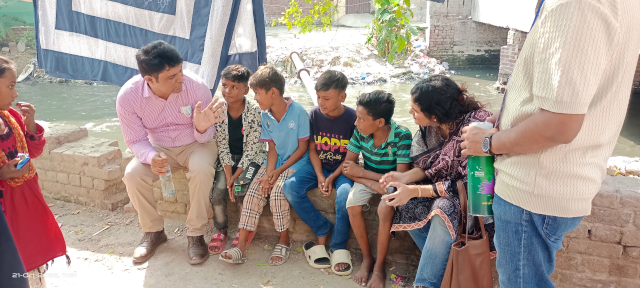
A group of university students, under the supervision of Human Rights activist Ashiknaz Khokhar, recently visited one of the most overlooked and marginalized Christian settlements in Lahore—an informal slum community built along a sewage and rainwater canal.

The stench of the polluted water fills the air day and night, a constant reminder of the environmental and human rights crisis unfolding at the heart of a thriving metropolitan city.
For more than 40 years, Christian families have lived on the narrow edges of this canal. Originally treated as “slums,” they began constructing homes along the polluted waterway because no one objected—no developer, no government body, and no influential landowner.
At that time, the land was considered too hazardous to be of value. Today, however, the surrounding area has become high-priced real estate, but the residents themselves have no property rights, no protection, and no recognition of their decades-long existence.
Most of the residents belong to historically marginalized Dalit backgrounds, tracing their roots to colonial-era conversions to Christianity. The discrimination they face is therefore two-fold: first as religious minorities in Pakistan, and second within their own broader Christian community due to caste-linked prejudices.
The economic realities are harsh. Men often work low-paid garbage-collection jobs, women are employed as domestic workers, and children continue to be trapped in child labour, a cycle repeated across generations.
Some young boys and girls also face sexual harassment and molestation, a danger amplified by their social vulnerability and lack of community protection.
Education, the only powerful pathway out of poverty, remains largely inaccessible. Private schools are unaffordable, missionary schools are both distant and expensive, and public schools become another site of humiliation for these children.
Among the children living here is David, an eight-year-old Christian boy. Like many others, he dreams of going to school, playing with friends, and leading a life free of fear. But reality is starkly different.
Muslim children in nearby areas refuse to play with him, often hitting him and calling him the derogatory slur “Chora,” a deeply insulting term historically used to belittle Christians. The word carries connotations of caste, impurity, and servitude—a psychological wound that marks David long before he fully understands its weight.
For David, discrimination is not an occasional experience; it is a daily reality. His story is one of many, reflecting the circumstances that shape the childhoods of minority children living in vulnerable environments.
At 52, Martha Bibi is a cardiac patient who often struggles even to stand without support. The polluted air around the canal has already weakened her lungs; respiratory problems, asthma, and chronic infections are widespread in her community.
When she visits public hospitals, another barrier emerges. She is routinely denied free essential medicines because they are purchased with Zakat funds, reserved strictly for Muslim patients. As a Christian woman battling poverty and illness, she must pay out of pocket for treatments she cannot afford.
This systemic denial of care reflects the structural inequalities that minorities face, even in life-and-death situations.
In this settlement, the average male life expectancy is only 50–55 years due to prolonged exposure to sewage fumes, toxic waste, and dirty stagnant water. Skin diseases, chest infections, and respiratory disorders are widespread.
With no government development programs, no sanitation services, no clean drinking water, and almost no pastoral or church support, the community remains stuck in a generational crisis.
This is not only a social injustice—it is a climate justice issue. These families are forced to bear the brunt of environmental pollution created by a city that has given them nothing in return.
The visit by Ashiknaz Khokhar and his students revealed a truth often ignored: these families do not lack potential—they lack opportunity. If the government, churches, or civil society organizations establish even basic education centres, skill training programs, or community schools, it could transform entire generations.
A small investment in literacy, vocational skills, climate resilience training, health awareness, and child protection could uplift more than 90 families from poverty, exploitation, and hopelessness.
This community—despite facing discrimination from society, government systems, and even within Christian structures—remains resilient. What they need is recognition, rights, and respect.
The Christian families living along Lahore’s sewage canal have survived decades of neglect, discrimination, and environmental suffering. They are citizens of Pakistan, yet invisible in policy, planning, and protection.
Their struggles must not remain hidden. Their stories must not go unheard.
This community deserves property rights, clean air, safe water, education, healthcare, and equal dignity—the same rights guaranteed to every Pakistani.
And if institutions take notice and extend support, then children like David, women like Martha Bibi, and hundreds of forgotten families may finally step toward a life of dignity—one they have been denied for generations.
For more information
Ashiknaz Khokhar
This email address is being protected from spambots. You need JavaScript enabled to view it.
Whatsapp: 00923016909634